What Duolingo gets right that most AI lessons get wrong
Millions of people open a language app every day without anyone making them. Most students forget a textbook AI chapter within a week of the test. The difference isn't the cartoon owl. It's five design decisions that any school AI program can borrow.
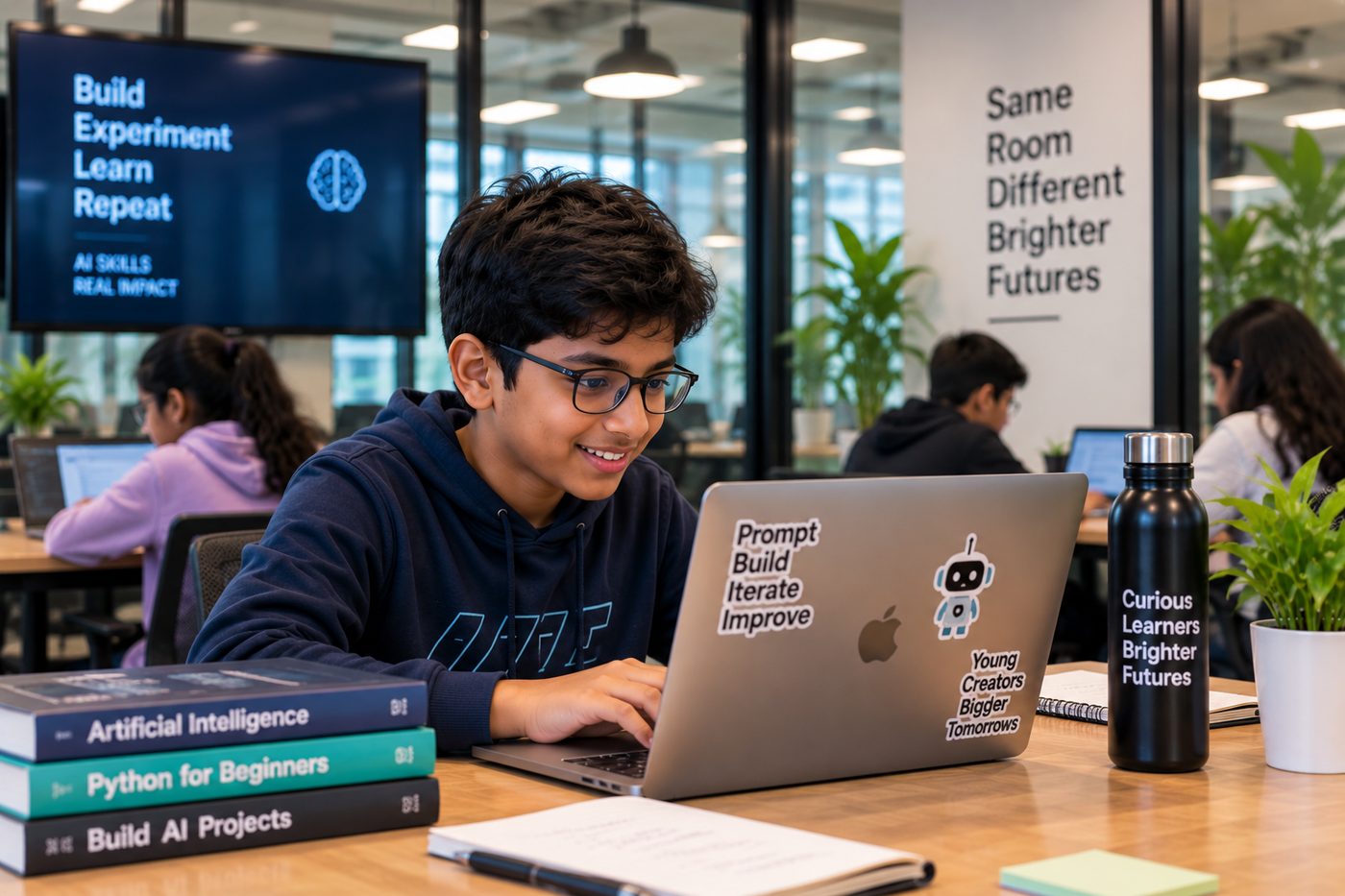
Watch a teenager use a language app for five minutes. A lesson takes about three minutes. Every answer gets a response in under a second, and a wrong answer comes with the reason. The word they got wrong yesterday comes back today, in a different sentence. The app knows which words they have mastered and which they keep fumbling, and it quietly spends more time on the second list.
Now picture how AI usually arrives in a Grade 9 classroom. A definition to copy. A diagram of the three domains. Five multiple-choice questions at the end of the unit, marked a week later. A test in March. By April, most of it has gone.
We use Duolingo as shorthand because almost every parent and teacher has seen it. We are not affiliated with it. But when we designed our AI lessons, we borrowed shamelessly from the ideas underneath it. Here are the five that matter most.
1. Make it small enough to start
"Unit 1: Artificial Intelligence and its domains" is a wall. "Find the AI hiding in Riya's school day" is a door. A child will happily start a five-minute mission they would never start as a forty-page chapter, and once they've started, they keep going.
Small also means one idea at a time. A mission about Computer Vision should not also be teaching the project cycle. One idea, played with, checked, done.
2. Feedback in one second, with the reason
A red cross teaches almost nothing. The useful part of feedback is the why, and the most useful why names the exact misunderstanding behind the wrong answer. Compare "Incorrect" with: "A FASTag lane isn't AI. It reads a radio tag and follows a fixed rule. The camera that reads number plates is the AI."
That second sentence fixes a specific idea ("automatic means AI") at the moment the child is paying attention. Marked a week later, the same feedback lands on a child who no longer remembers what they were thinking.
A toll barrier lifts automatically when your car's FASTag is read. Is that AI?
3. Mistakes come back, but never the same question
In the 1880s the psychologist Hermann Ebbinghaus showed how quickly we forget new material unless we come back to it, and a century of research since has added two practical findings. Being asked to recall something strengthens memory far more than rereading it. And reviews spread out over days work better than one big revision session.
Language apps build both into their design. A word you got wrong comes back later that day, then days later. School AI lessons almost never do this. A wrong answer gets marked and is never seen again, so the misunderstanding comes back too, usually in the exam.
There's a catch. If you re-ask the identical question, students memorise the answer, not the idea. So the question has to change while the idea stays the same. A child who thought a timer street light was AI should next meet an automatic hand dryer, then a calculator.
4. Reward mastery, not attendance
Badges for finishing a level teach children to finish levels. Press "It's AI" every time and you still reach the end. Points become the point, and the learning leaks out.
The older idea is mastery learning, which the educational psychologist Benjamin Bloom developed in the 1960s: a student moves on when they have shown they understand, not when the calendar says so. In practice that means a level unlocks the next one only at around 80% correct, stars reflect accuracy rather than effort, and a student who falls short revisits the idea they missed and tries new questions on it.
The most underrated reward is the one for fixing a mistake. "Mistake fixed" should feel as good as getting it right the first time, because for learning it is worth more.
A student scores 60% on a level about Computer Vision. What should happen next?
5. Streaks, handled carefully in school
Streaks are powerful because nobody wants to break one. They can also turn into guilt, and guilt is a poor teacher. In a school setting we prefer weekly goals and class-wide progress to individual daily streaks, and we never publish a leaderboard that ranks the weakest students in front of their friends.
Game mechanics are the wrapper, not the content. They earn the first five minutes of attention. What keeps a student is the feeling of getting better at something real.
5 min — two questions on last week's mistakes, asked differently. 10 min — a real-world mission and a prediction. 15 min — a hands-on lab, in pairs. 10 min — a mastery check with instant feedback. 5 min — one "why?" question to leave with. We set out the full plan in a curiosity-first AI period.
The test
Watch what happens when the bell rings. If students ask whether they can finish the level, the design is working. Then look at the class record: are the same misunderstandings showing up week after week, or are mistakes actually getting fixed? The first tells you they're engaged. The second tells you they're learning.
AI Kids Lab turns the CBSE AI curriculum for Grades 7, 8 and 9 into gamified lessons designed by product engineers, inside your school's existing timetable. Try a free lesson (no sign-up), or book a 30-minute call.
Talk to us on WhatsApp