What it teaches
Three domains of AI, each learned by doing.
Each domain gets its own lab, with a toy to play with before the idea gets its name. The memory hook students leave with: Data counts, Vision sees, Language talks.
Domain oneData
A Rock-Paper-Scissors AI starts knowing nothing, studies the student’s moves, and starts winning. Then: weather forecasts, fraud alerts, delivery times and IPL win predictors.
Domain twoComputer Vision
Students paint on a pixel grid and watch it turn into the numbers a computer stores, then guess pictures from a handful of pixels. Then: face unlock, crop-disease apps and India’s tiger count.
Domain threeNatural Language Processing
A mood-reading AI is made happy, then sad, then flipped with “not”, then fooled with sarcasm. Students build a sentence one predicted word at a time, the way a chatbot does.
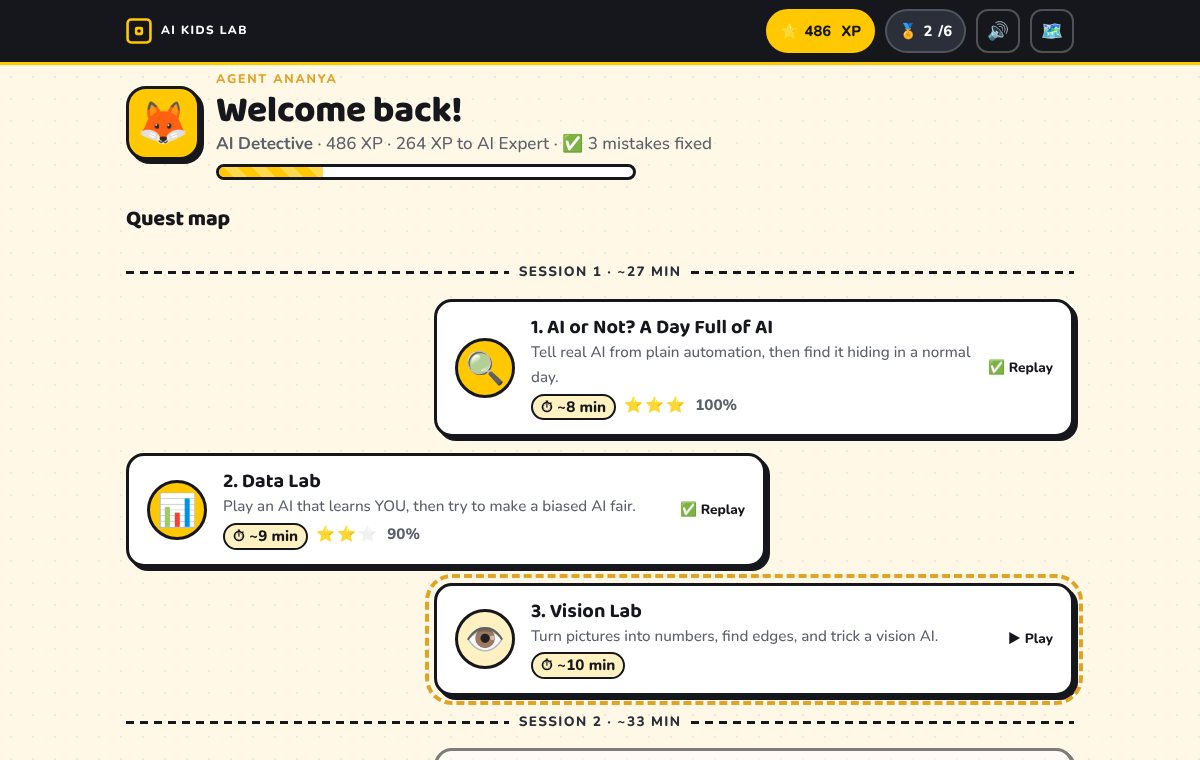
Level 1 · ~8 minAI or Not? A Day Full of AI
Ask a calculator and a maps app the same question three times. Only one answer changes — that’s the test for AI. Then find it hiding in a school day.
Level 2 · ~9 minData Lab
Play an AI that learns your habits, then fix a kabaddi-team picker that learned from one-sided data.
Level 3 · ~10 minVision Lab
Pixels become numbers, edges become shapes — then dim the light and turn the photo to make the AI unsure.
Level 4 · ~10 minLanguage Lab
Mood missions with sarcasm and Hinglish, a next-word keyboard, and the steps inside “Hey Google, aaj barish hogi?”
Level 5 · ~9 minSort & Mash-up
Speed-sort real apps, take apart multi-domain systems, and be the human who checks an AI’s decisions.
Level 6 · ~8 minBoss: GLITCH
A mistake review with “why?” questions, then a boss battle that draws on everything learned.
Finale · ~6 minDesign your own AI
Pick a real problem, choose the data, think about who could be treated unfairly, and download your idea card and certificate.
Built inMistakes that come back
Every wrong answer is tagged with the misunderstanding behind it and returns as a different question until it’s fixed — even on the next visit.