Onboarding CBSE partner schools for 2026–27
Hyderabad first, then across India

The AI class children don't want to end.

Gamified, story-led AI lessons for CBSE Grades 7, 8 and 9 — designed by engineers who build products at Google, Apple, Amazon and Microsoft. Every lesson walks a child through a real-world problem, so curiosity does the teaching. And every month, one of those engineers is on your campus.

Grades7, 8 & 9
CurriculumCBSE AI
Engineer on campusEvery month
Free lessonNo sign-up
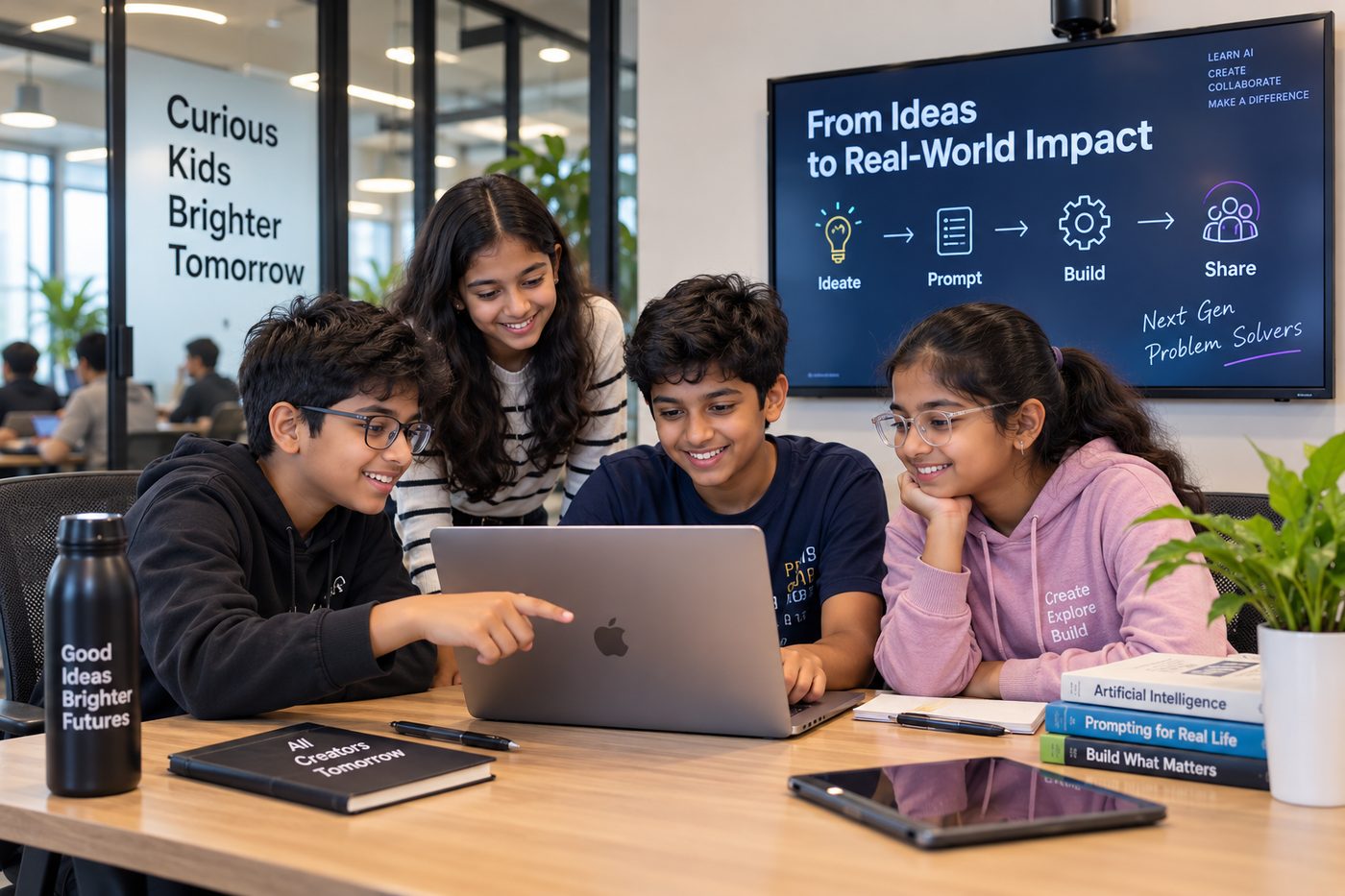
Students working through an AI lesson together in a school computer lab
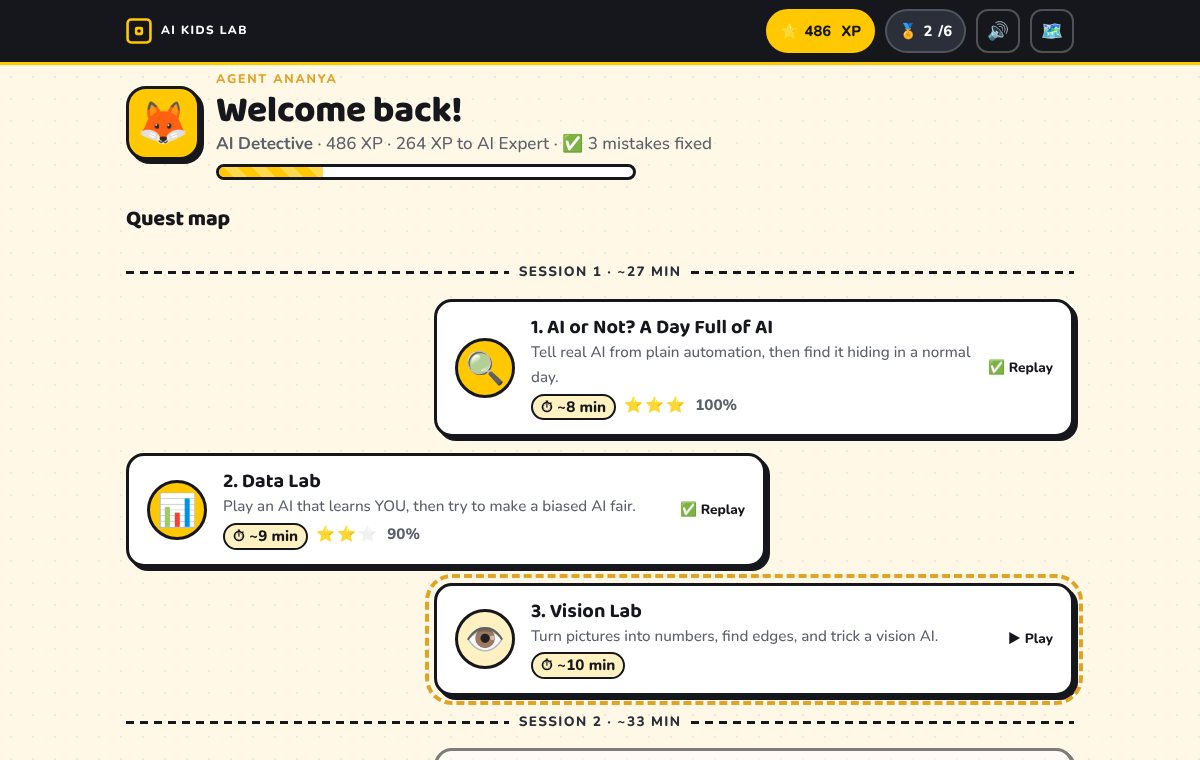
12-day streak Mistake fixed Certificate earned
12 1,240 XP
Level 3 · Vision Lab7 / 10

A camera at a toll plaza reads your car's number plate. Which AI superpower is it using?

AData — spotting patterns in numbers
Computer Vision — reading images
CLanguage — understanding words

Every game, lab and lesson is designed by engineers who have shipped real AI and software at companies like these — IIT, IIIT and BITS alumni. The same engineers walk into your classrooms every month. They're not trainers reading from a deck.

Google
Apple
Amazon
Microsoft
CoinDCX
Zepto
Slice
The gamified experience

Think Duolingo — for AI, built for Indian classrooms.

We replaced lecture videos with something children actually come back to: short missions, hands-on labs, streaks and XP. Underneath the play sits a serious learning engine, designed by engineers who build products at Google, Apple, Amazon and Microsoft — so the fun always leads to understanding.

Start with the real world

Every lesson opens with a story a child recognises — a UPI fraud alert, the camera at a toll plaza, a voice assistant that answers in Hindi.

Mission

Play to understand

Labs where AI behaves in front of them: an opponent that learns their rock-paper-scissors habits, a drawing turned into numbers, real Python in the browser.

+XP

Mistakes come back, smarter

Every wrong answer is tracked by the idea behind it, then returns as a different question — later that day, then days after — until it's fixed.

Streak

Master it, then earn it

A topic only counts as done at 80% mastery. Each one ends in a certificate the child downloads — and a progress record the teacher can see.

Certificate
Screens from the free AI Reflection Quest lessonFree lesson
Try it before you talk to us

Play the free AI Reflection Quest.

  • Find the AI hiding in a normal day, and learn its three superpowers: data, computer vision and language
  • Six levels with three hands-on labs and a boss, straight from the CBSE Class 9 AI syllabus — about an hour, in two short sessions
  • Mistakes come back as new questions until they're fixed, and a level unlocks only at 80% mastery
  • Works on any phone or laptop. No sign-up, nothing to install
Start the free lesson
Why school leaders are moving now

Every parent is already asking what your school is doing about AI.

The boards have added AI to the syllabus. The parents have read the headlines. What most schools don't have is a credible way to actually deliver it — taught by people who build this for a living, with something at the end of the year the child can show.

The syllabus moved

AI and computational thinking are now part of the curriculum across boards. Coverage is expected; depth is not yet delivered.

Faculty were never trained for it

Your CS teachers are excellent at what they were trained in. Nobody trained them on models, prompting, or shipping an AI product.

Admissions are competitive

Robotics labs and smart boards are table stakes now. Students who have built and pitched a working AI product are not.

There is no free period

Any program that demands extra hours, extra staff or a parallel timetable quietly dies by December. This one is built to fit.

See what a teenager can actually build Eight documented cases — a wearable for a grandmother with Alzheimer's, heart screening in seven seconds, a thresher that stopped a classroom coughing
How it runs inside your school

One period a week. One expert day a month. One capstone a year.

We don't ask you to find new hours or hire new staff. The gamified curriculum runs in a single existing period, with each child moving at their own pace. Once a month, an industry engineer walks into your campus to clear doubts — and by the end of that same day, every child has demoed what they built.

Weekly Play

Gamified lessons & labs

Story-led missions, interactive AI labs, real Python in the browser and mastery checks — each child at their own pace, in one timetabled period.

  • Runs on your existing computer lab
  • Every mistake tracked and re-taught
  • A certificate for every topic mastered
Monthly Live

Industry engineer, on your campus

A full day with an engineer who builds AI for a living — not a guest lecture, a working session.

  • Doubt-clearing clinic on the month's modules
  • Live build sprint on the class project
  • Showcase the same day, before they leave
Every term Build

A capstone that differs by grade

Grade 7, 8 and 9 each build something pitched at their level — never the same project recycled across grades.

  • Solves a real problem the student picks
  • Assessed on a written rubric
  • Documented with photos and video
Once a year Boss level

Build-a-thon & award ceremony

A full-day build event for the whole school, ending in an awards ceremony for the strongest projects.

  • Judged by industry mentors
  • Top projects recognised on stage
  • A story and a reel your school owns
Also includedTeacher workshopsCompetition supportIncubation via partners

Typical commitment: one 45–60 minute period per week, plus one full expert day each month. No parallel timetable, no weekend classes, no additional teaching staff.

The curriculum

Three grades. Three different programs. Three different capstones.

Mapped to the CBSE AI curriculum for Classes 7, 8 and 9, and taught through play. A Grade 7 student and a Grade 9 student should not be handed the same worksheet: each year builds deliberately on the last — from understanding how AI thinks, to shipping a working product, to standing up and pitching it like a founder.

Grade 7 · Year One

AI Literate

Understand it, direct it, train your first model.

What they learn

  • How AI actually works — data, patterns and prediction, taught without the maths jargon
  • Prompting as a real skill: directing ChatGPT, Claude and Gemini to do useful work
  • Training their first model themselves, on images, sound or gestures
  • Creative AI: images, audio and storytelling, with a critical eye
  • Safety and ethics: bias, deepfakes, and what never to share with a model
  • First builds with block-based and no-code tools
Google Teachable MachineTensorFlow PlaygroundScratch + AIChatGPTClaudeGeminiCanva AI
Capstone AI for my classroom

A trained model or simple assistant that solves a problem inside their own school — a waste-segregation sorter, a lost-and-found identifier, a revision helper for their toughest subject. Built, tested, and presented to their class.

Grade 8 · Year Two

AI Builder

Turn a model into a product people can use.

What they learn

  • From model to product: how an AI application is actually assembled
  • Working with data — collecting, cleaning and labelling a dataset of their own
  • Building real apps with vibe-coding and no-code tools
  • Python foundations: enough to read, debug and change what the AI writes
  • Assistants that answer from their own documents and notes
  • Testing with real users: does this work for anyone other than me?
Google ColabPython basicsscikit-learnKeras / TensorFlowMediaPipesentence-transformersEmbedding ProjectorHugging FaceReplitLovableCursorMIT App Inventor
Capstone AI for my community

A working AI app or assistant aimed at a real problem beyond the classroom — a local-language study helper, a plant-disease checker for a family farm, a safety or accessibility tool. Shipped, put in front of real users, and improved on their feedback.

Grade 9 · Year Three

Young Founder

Find a real problem. Build the MVP. Pitch it.

What they learn

  • Finding a problem worth solving, and talking to the people who have it
  • Product thinking: scope, MVP, and deciding what to build first
  • Building an end-to-end product with AI tooling, start to finish
  • Measuring what matters — is anyone actually using this?
  • Business basics: who pays, what it costs, how it could grow
  • The pitch: telling the whole story in five minutes, on a stage
LLMs via managed gatewayAI coding assistantGradioWhisper (speech-to-text)OCR & text-to-speechGoogle Slides / CanvaFull-stack AI toolingUser researchAnalyticsUnit economicsPitch craftDemo day
Capstone Venture-ready build

A working MVP with real users, a set of numbers behind it, and a founder's pitch delivered to a panel of industry mentors. The strongest go forward to the Build-a-thon, into national competitions, and on to the student incubation labs we collaborate with.

Curriculum fit

Built on the CBSE AI curriculum. It reinforces your syllabus.

We start from the CBSE AI curriculum for Classes 7, 8 and 9 — including the Artificial Intelligence subject (417) in Class 9. Before day one, we sit with your academic team and map every lesson against what you already teach.

CBSE · Class 7
CBSE · Class 8
CBSE · Class 9 · AI (417)

Running ICSE, IB, Cambridge or a state board? Talk to us — we map the program to other boards on request.

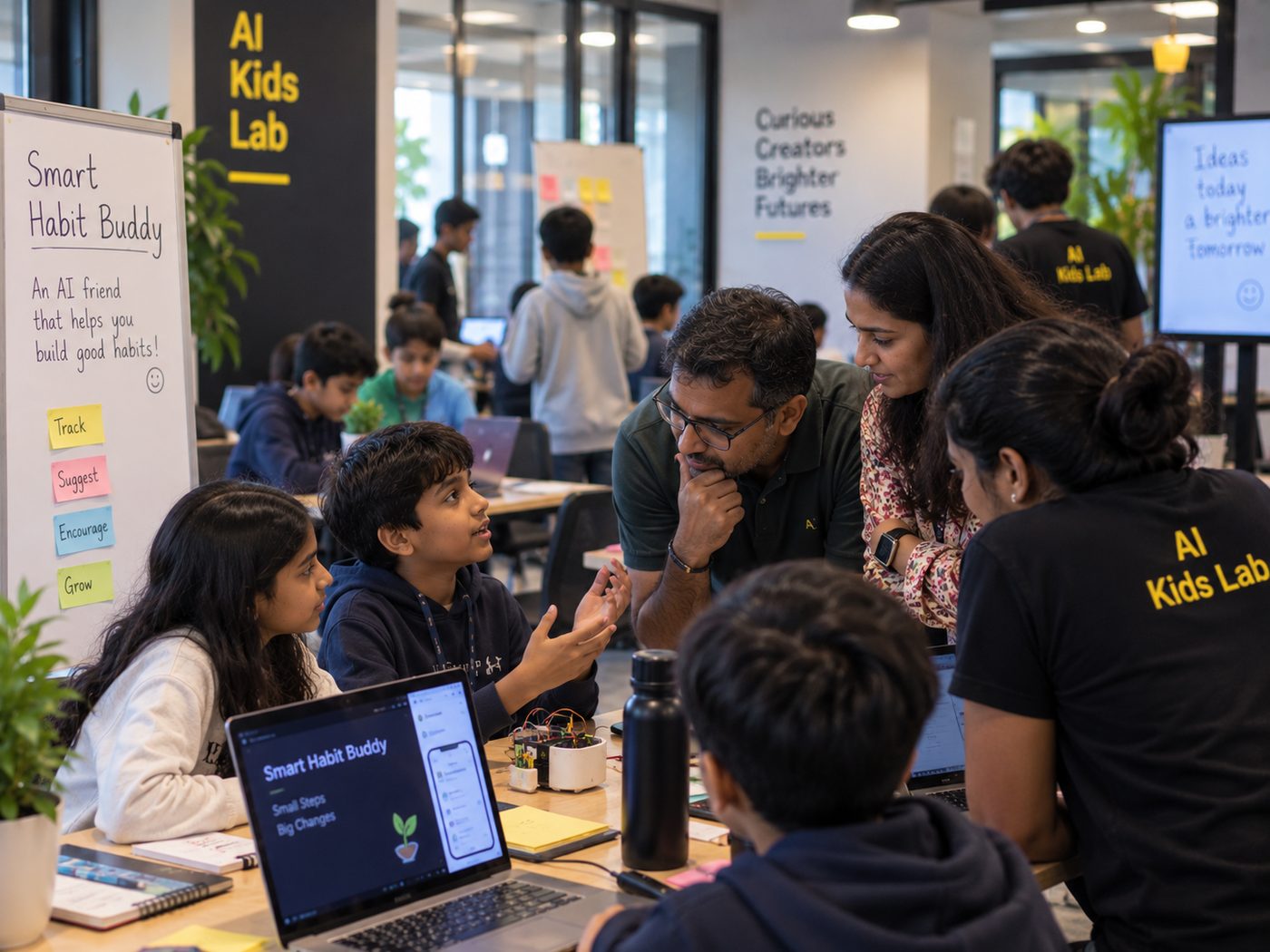
Students demoing their AI projects at a school build event
Once a year, per school

The Build-a-thon.

One day where the whole school builds — and the best of it gets a stage, a trophy and a photograph that ends up on your wall.

01

Everyone builds

Teams across Grades 7, 8 and 9 build against a theme, in a single day, with mentors on the floor.

02

Industry mentors judge

Projects are judged by engineers and founders on a published rubric — problem, build, and pitch.

03

Top projects are picked

The strongest builds from your school are selected, documented and taken forward.

04

Award ceremony

Winners are recognised in front of the school and their parents, with photos and video your school keeps.

Where it goes next

Your Build-a-thon isn't the finish line.

Every student is prepared for the national and global competitions that take AI projects seriously — and the strongest Grade 9 builds get introduced to the student incubation labs we work with. See what students this age have actually gone on to build.

Indian National AI OlympiadACM India

The national pathway to the International Olympiad in AI. We prepare students for the syllabus and the selection rounds as part of the year.

Technovation GirlsGlobal

Team app and AI projects built around a community problem — the same brief our Grade 8 and 9 capstones already train for.

Imagine Cup JuniorMicrosoft · ages 13–18

AI for Good. Students enter with a working build and an honest evaluation behind it, not a concept slide.

ATL MarathonAtal Innovation Mission

For schools with an Atal Tinkering Lab, our capstones plug straight into the national innovation challenge.

MIT App InventorHackathons & showcases

Global showcases for student-built apps, with a route for the mobile interfaces students build in Grade 8.

And for the ones who want to build a business.

A Grade 9 student who finishes with a working product and real users shouldn't stop at a trophy. We introduce the strongest builds to the student incubation labs we collaborate with, and help the student prepare for that conversation.

An MVP with real users, built in the Grade 9 capstone
Selected at your school's Build-a-thon, judged by industry mentors
Introduced to a partner student incubation lab, with the pitch prepared
What your school gets

A program that shows up in your admissions conversation.

Not a certificate you hand out at the end of the year. Evidence — student by student, project by project — that your school is genuinely doing this.

A gamified, grade-wise curriculum

Grades 7, 8 and 9, fully built as games, labs and mastery checks, and updated as the tools change. Nothing for your team to write.

Teacher workshops

Hands-on workshops train your faculty to run the period and grow into the subject, instead of being replaced by an outside vendor.

An industry expert every month

Background-verified engineers from real AI and product teams, on your campus, in front of your students.

Progress reports you can send home

Per-student progress each term — topics mastered, mistakes fixed, project stage, and a rubric score parents can read.

A portfolio per student

Every child leaves each year with a working build and a documented project, not a participation certificate.

An annual event worth covering

The Build-a-thon and award ceremony give you a story, a reel and photographs for parents, alumni and the press.

The AI-Enabled School seal: a gold verified tick inside a ring reading AI-Enabled School, AI Kids Lab, 2026–27
The verified mark

Become an AI-Enabled School.

Every school says it covers AI. Partner schools that run the full program earn the AI-Enabled School badge — a verified mark, renewed every year, for your website, your social profiles, your admissions brochure and your reception wall. Like the tick next to a name on Instagram or X, it tells parents this is the real thing.

What it takes to earn it
Safety, privacy & responsible AI

Built for a school's duty of care, not bolted on afterwards.

Everything your leadership team, your counsellor and your parent committee will ask — answered before they have to ask it.

Two schools, five years from now

The same AI line in the syllabus, delivered two very different ways. Weighing us against the other in-school options? We set those out plainly in how we're different.

AI as a textbook chapter

  • Students memorise a definition of AI for the exam, and forget it after
  • They can define what AI is, and have never built anything with it
  • The subject rests entirely on one teacher who was never trained for it
  • The same content is taught to Grade 7 and Grade 9 with the slides barely changed
  • At an admissions meeting, "we cover AI" sounds like every other school in the city
  • Nothing to show parents at the end of the year but marks

AI as something they build

  • Children ask for the AI period, because it plays like a game they want to win
  • Every student in Grades 7–9 finishes the year with a working AI project of their own
  • Your faculty are trained and supported, with an industry expert on campus monthly
  • Grade 7, 8 and 9 each run a distinct curriculum and a distinct capstone
  • You can name the products your students shipped, and show the demo video
  • An annual Build-a-thon, an award ceremony, and students on a path towards incubators

We're changing the way children learn AI.

Not by adding another chapter to memorise, but by letting them play with it, build with it and pitch what they built. India does not have a shortage of bright children. It has a shortage of places where a fourteen-year-old is taken seriously enough to build something real and be asked who it is for. Our mission is to bring AI education into schools in a form that produces builders — students who leave Grade 9 having identified a genuine problem, shipped something that works, and stood in front of a room to defend it. Not because it fills a line in the syllabus, but because the next decade belongs to people who can build, and India should be producing them from the classroom up.

Where your students end up

National competitions, and a route to incubation. Every student is prepared for the national and global AI competitions that take student work seriously. The strongest Grade 9 builds go further: we introduce them to the student incubation labs we collaborate with, so a product with real users can become an actual business — and the school that started them gets to say so.

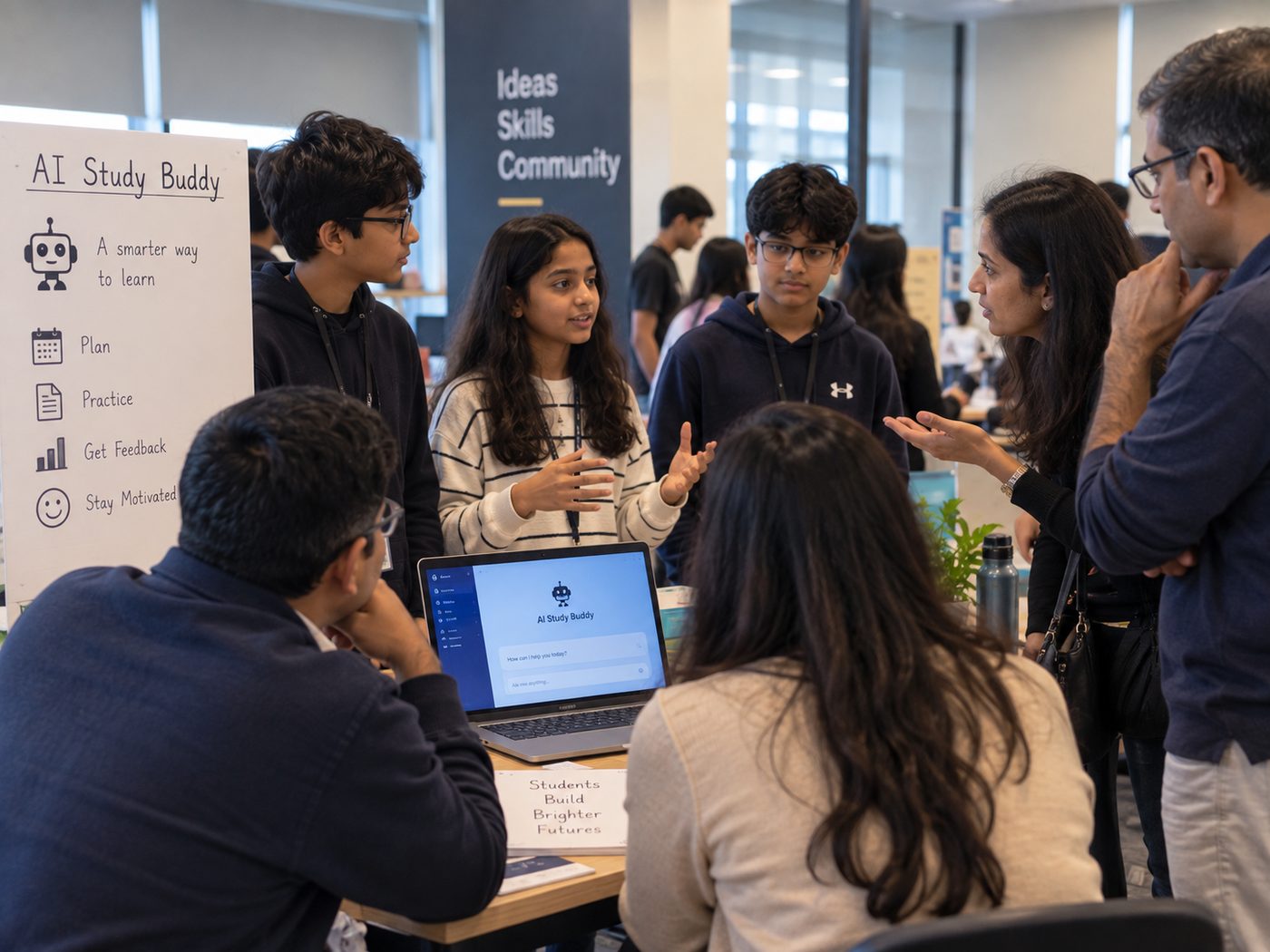
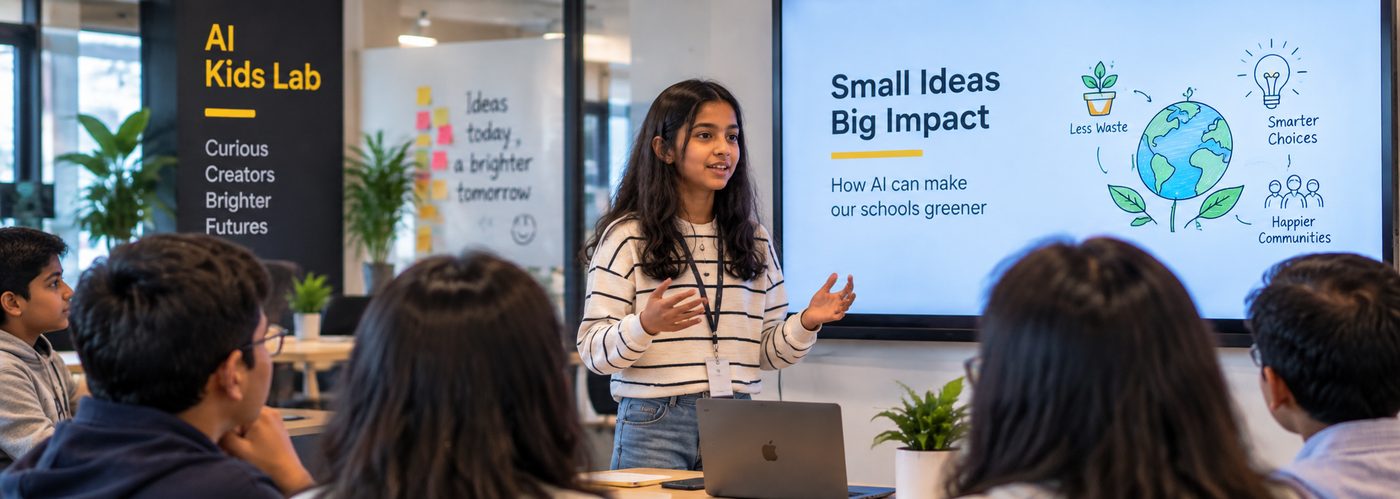
A student presenting the AI project she built for her school
Getting started

From first call to first class in about four weeks

We onboard a limited number of schools each academic year, because every school gets a curriculum mapping session and a named expert for its monthly days.

Level 1

Discovery call

Thirty minutes with your leadership team. Your board, your grades, your lab, your timetable — and an honest view of what this will and won't do.

Level 2

Curriculum mapping

A working session with your academic coordinator and CS faculty to map our modules onto your existing syllabus and calendar.

Level 3

Teacher enablement workshops

Hands-on workshops for the teachers who will run the weekly period. We set up the lab and student logins, and brief parents if you'd like us to.

Level 4

Launch & review

Classes begin, the first expert day lands within the month, and we review progress with you at the end of every term.

Want to start smaller? Many schools begin with a single grade for one term, see the capstones, and extend to all three grades from the next academic year.

Who you'd be partnering with

Two founders who have spent their careers close to how technology actually gets built, and an advisor who spent his running the public education system it has to work inside.

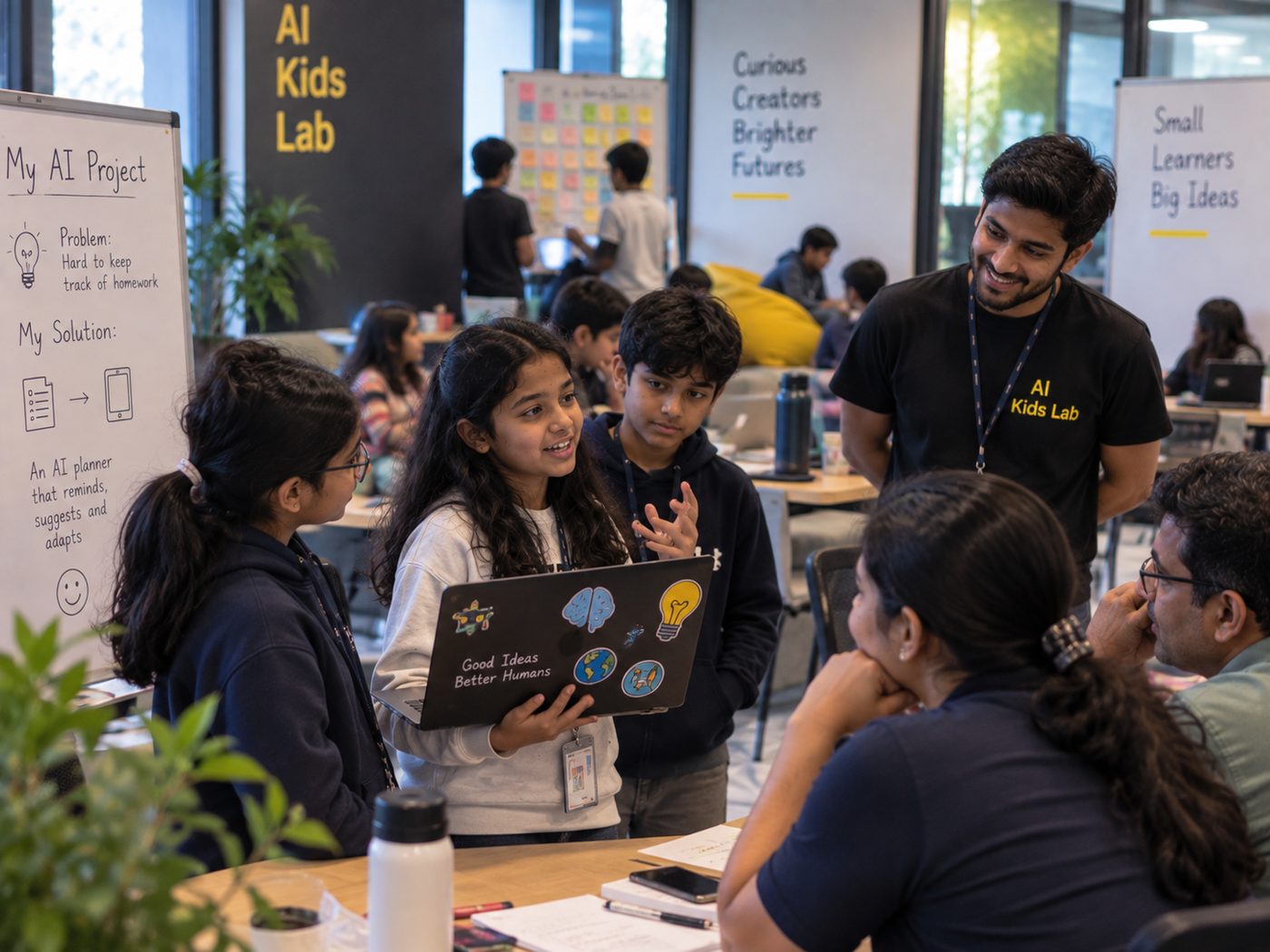
Students presenting their AI project work

Ramya

Founder

Ramya has spent 11+ years building go-to-market strategy for B2B SaaS companies, most recently leading marketing at Syntasa, an agentic marketing platform built on Google Cloud, while co-founding GetSeenInAI, an AI-visibility platform, and B2B Growth Boost, a growth agency for SaaS and B2B companies. Along the way, she's advised more than 40 companies on how to grow in a world being rewritten by AI.

She's an ISB alumna through its Chief Growth and Marketing Officer program, an AI Fellow with Outskill, and a graduate of Growth School's Advanced Gen AI program, along with their SaaS Growth and Growth Hacking mentorships, B2B Marketing, Performance Marketing, ChatGPT 101 and Gen AI workshops.

A three-time founder, she speaks on AI in marketing at T-Hub, has been invited to judge and mentor student AI projects at multiple universities, and organizes developer communities around vibe coding for launching AI products.

She's also a mother of two, which is the real reason AI Kids Lab exists — and the reason it now works with schools rather than around them. A rushed module or a generic app was never going to be enough, and no individual program reaches the number of children a school does.

ISB alumna11+ yrs B2B GTM3x founderSpeaker & judgeFounder, GetSeenInAIFounder, B2B Growth BoostMom of 2

Kumar

Co-Founder, Technical Lead

Our technical co-founder has built and tested software at scale across Apple, Amazon, and fast-growing product companies including CoinDCX, Zepto, and Slice, specializing in SDET, DevOps, and automation at scale.

That builder's discipline shapes the curriculum directly: nothing enters a module until it has genuinely been shipped somewhere first. What your students learn is the technology actually running in production, not a simplified textbook version of it — and the industry experts who come to your campus are drawn from the same network.

Ex-AppleEx-AmazonCoinDCX · Zepto · SliceSDET & DevOpsAutomation @ Scale

D. Chakrapani, IAS (Retd.)

Advisory Board

Mr Chakrapani spent a career inside the machinery that runs education in this state. He joined the State Civil Services in 1977 and was appointed to the Indian Administrative Service in 1983, and served as Commissioner and Director of Intermediate Education in the Government of the erstwhile Andhra Pradesh — the office responsible for the colleges that take students straight out of the grades we teach.

His wider career spans Secretary (Projects) in the Irrigation Department, Managing Director of the AP State Co-operative Bank, and Additional and Special Secretary in Finance and Planning, where he oversaw externally funded projects. He retired in July 2011 as Additional Director General of the Dr. Marri Chenna Reddy Human Resource Development Institute in Hyderabad, the state's training academy for its own officers.

Since retiring he has worked on exactly the problem this company exists for: getting something that works in one place to work everywhere. He served as Director of the Centre for Innovations in Public Systems in Hyderabad, and later as Director General of the AP Human Resource Development Institute.

He advises us on the part founders are worst at — how a program actually survives contact with a school system, a state syllabus and a public institution, rather than working beautifully in one enthusiastic school and nowhere else.

  • IAS, 1983 batch — State Civil Services from 1977
  • Commissioner & Director of Intermediate Education, Govt. of Andhra Pradesh
  • Retired July 2011 as Additional Director General, Dr. MCR HRD Institute, Hyderabad
  • Director, Centre for Innovations in Public Systems, Hyderabad
  • M.A. English, Osmania University · Diploma in English Studies, CIEFL
IAS (Retd.)Intermediate EducationDr. MCR HRD InstitutePublic systems innovation
Partner with us

Bring AI Kids Lab to your school

Send us one message and we'll reply with the curriculum guide and the program plan. If it looks like a fit, we'll set up a 30-minute walkthrough for your leadership team. Or play the free lesson first — no sign-up.

Prefer email or a calendar invite? Write to ramyaaikidslab@gmail.com or pick a slot directly.

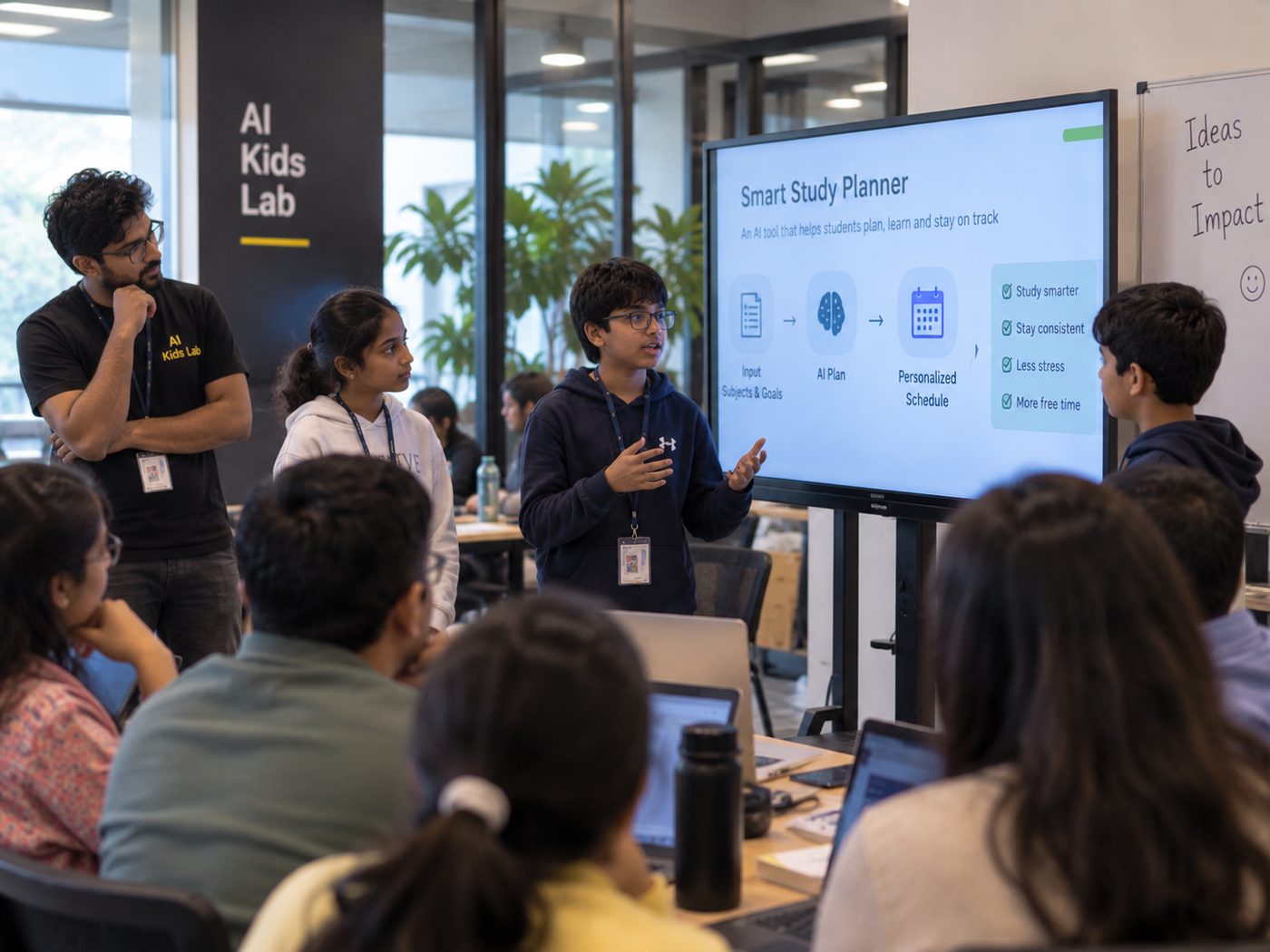
A student demonstrating a working AI tool to mentors

What we'll cover on the call

  • The full lesson map — the games, labs and projects students actually play and ship
  • How it maps onto the CBSE AI syllabus and your timetable
  • What your lab, your coordinator and your faculty need to do
  • Safeguarding, student data and how AI access is managed
  • The Buildathon format, and commercials for your section counts

Questions school leaders ask

Which grades does this cover? +
Grades 7, 8 and 9 of the CBSE curriculum, with a distinct curriculum and a distinct capstone project for each year. Grade 7 builds AI literacy and trains a first model, Grade 8 ships a working application, and Grade 9 works like a founder — problem, MVP, users and a pitch.
What does "gamified" actually mean here? +
Each topic is a short mission built around a real-world example: interactive labs where children watch AI behave, quick questions with instant feedback, XP, streaks and levels. It isn't decoration — every mistake is tracked by the idea behind it and comes back as a different question until it's understood, and a topic only counts as done at 80% mastery. The experience is designed by engineers who build products at Google, Apple, Amazon and Microsoft.
Can we try it before we talk to you? +
Yes. The AI Reflection Quest is a complete free lesson from the CBSE Class 9 AI syllabus. It works on any phone or laptop, with no sign-up and nothing to install — hand it to a student and watch.
What is the AI-Enabled School badge? +
A verified mark, renewed every academic year, for partner schools that run the full program: every student in the participating grades learning on the platform with mastery tracked, teachers trained, monthly engineer days, capstones and an annual Build-a-thon. Schools use it on their website, social profiles and admissions material, and verified schools are listed on our AI-Enabled Schools page. It is AI Kids Lab's certification, not a government one.
How much timetable time does it need? +
One 45–60 minute period a week, usually the computer or skill period you already have, plus one full expert day a month. There is no parallel timetable, no weekend classes and no additional teaching staff to hire.
Will this clash with our board syllabus? +
No — it's built on it. The program follows the CBSE AI curriculum for Classes 7, 8 and 9, including the AI subject (417) in Class 9, and before launch we map every lesson against your own calendar with your academic coordinator. Schools on ICSE, IB, Cambridge or a state board can talk to us about a mapping.
Does it add to our teachers' workload? +
No. The lessons are gamified and run themselves — each child plays at their own pace, and the platform tracks progress and mistakes — so your teacher facilitates the period rather than preparing it. We also run hands-on teacher workshops so your faculty genuinely grow into the subject instead of being sidelined by an outside vendor.
What infrastructure do we need? +
An internet-connected computer lab with modern browsers, and ideally one device per one or two students. Everything runs in the cloud. No GPUs, no servers, no new hardware purchase.
What actually happens on the monthly expert day? +
An industry engineer spends the day on your campus. The morning is a doubt-clearing clinic on that month's modules, the middle of the day is a live build sprint on the class project with the expert on the floor, and before they leave, every team demos what moved that day. It's a working session, not a guest lecture.
How are students assessed? +
Each capstone carries a written rubric covering understanding, build quality, problem fit and presentation, alongside module completion tracked per student. Schools typically feed this straight into internal assessment and the term report card.
What does it cost? +
Pricing is per school, based on the grades you cover and your student numbers, and covers the curriculum, the platform, teacher enablement, the monthly expert days and the annual Build-a-thon. We share the full commercials on the demo call.
Can we pilot with one grade first? +
Yes, and many schools do. Start with a single grade for one term, see the capstones the students produce, and extend to all three grades from the next academic year.
Are the experts who come on campus verified? +
Every expert is background-verified, briefed before each campus visit, and assessed on how well they work with 12–15 year olds, not just on their engineering résumé. An AI Kids Lab team member is present through the whole day. Our full child-safety policy, consent process and campus protocol are shared before you sign anything.
What about student data and online safety? +
No student ever needs a personal AI account. Every model call and coding-assistant call runs through our managed gateway, so nothing a student writes lands in a consumer ChatGPT or Claude account. We collect only student name, class and a parent contact, with written consent, consistent with the DPDP Act 2023, and every school gets a named grievance and safeguarding contact. Nothing about a student is published anywhere without written parental consent.
Do students need prior coding experience? +
No. Grade 7 starts from zero and is built for students who have never written a line of code. Python appears only in Grade 8, and only as much as a student needs to read and change what AI writes for them.
What do parents see? +
A term-wise progress report for their child, the capstone their child built and presented, and an invitation to the annual Build-a-thon and award ceremony. We'll also run a parent orientation session at launch if you'd like one.
How long does it take to launch? +
Roughly four weeks from agreement: curriculum mapping, teacher enablement, lab and account setup, then classes begin, with the first expert day landing inside the first month.
Do you prepare students for competitions? +
Yes, as part of the year rather than as an add-on. We prepare students for the Indian National AI Olympiad (ACM India), Technovation Girls, Microsoft's Imagine Cup Junior, the ATL Marathon for schools with an Atal Tinkering Lab, and MIT App Inventor showcases. The capstones are built so a student can enter with working software and an honest evaluation, not a concept slide.
Do you work with schools outside Hyderabad? +
The curriculum and platform run anywhere in India. The monthly on-campus expert day is currently strongest in and around Hyderabad, and we're onboarding schools in other cities as we build the expert network there — tell us your city on the call and we'll be straight with you about what we can commit to.
What happens to the strongest student projects? +
They're selected at your school's annual Build-a-thon, judged by industry mentors and recognised at an award ceremony. From there they go into national and global competitions, and the strongest Grade 9 builds are introduced to the student incubation labs we collaborate with, so a product with real users has a route to becoming a business.