About AI Kids Lab

We build AI education inside schools, not around them.

Weekend programs reach the children whose parents already knew to look. A school reaches all of them. That difference is the whole reason this company works the way it does.

Why we started

It began as a weekend cohort for fifteen children.

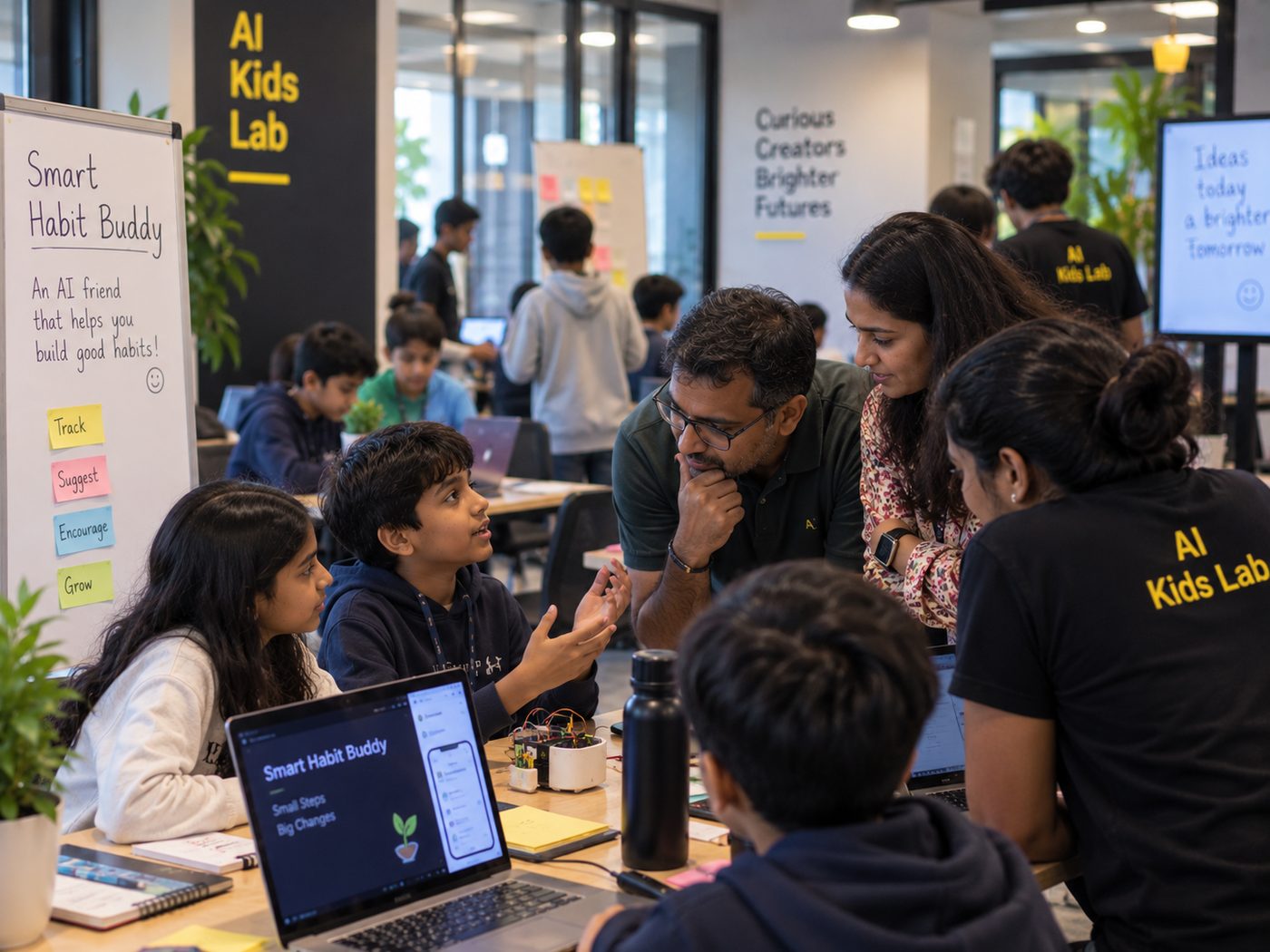
AI Kids Lab started because our founder, Ramya, was not willing to let her own two children learn AI from a rushed module or a generic app. The first version was exactly what you would expect: a small, in-person cohort in Hyderabad, fifteen seats, admission by interview, mentors who had actually shipped AI in production.

It worked. Children who had never written a line of code were training their own models within weeks and presenting working projects to a room of parents at the end.

But something about it kept bothering us. Every child in that room already had a parent who had gone looking. A parent who had read the headlines, searched, compared programs, and paid. The children who most needed to understand what AI is — and who it is being built by — were not the ones sitting in front of us.

A weekend program is a filter. A school is not. Inside a school, the curious child and the quiet one and the one whose parents have never heard the word "capstone" all get the same year.

So we rebuilt the whole thing for schools. The same mentors, the same insistence on building rather than watching, but delivered as a proper grade-wise curriculum that sits inside your existing timetable and reaches every student in Grades 7, 8 and 9 — not the fifteen whose parents found us.

And we changed how it is learned. Recorded lectures lose a thirteen-year-old in minutes, so every lesson is now a game: a real-world mission, a lab where the child watches AI behave, and mistakes that come back as new questions until they are understood. The experience is designed by engineers who build products at Google, Apple, Amazon and Microsoft — think Duolingo, for AI, built for Indian classrooms.

That is the company now. We are not an enrichment class that schools can refer parents to. We are the AI curriculum your school runs, with the people who build this technology walking into your classrooms every month. We are changing the way children learn AI.
What we believe

Seven things we will not compromise on.

These are not values on a wall. Each one changes what a Tuesday afternoon in your computer lab actually looks like.

01

The engine before the app

Most AI-for-kids courses start with an app template and an API key. It feels productive and teaches almost nothing, because an app is mostly screens and logins. Our students build the model first, then solve a problem with it, and add the interface last — which turns out to be the easy part.

02

Every student, not the keen few

We license per grade, so the whole cohort is included. AI literacy should not be an opt-in for the children whose parents pushed. The quiet student in the third row gets the same year as the one who already builds robots at home.

03

Designed and taught by people who ship

The games, labs and lessons are designed by engineers who have built products at Google, Apple, Amazon and Microsoft, and nothing enters a lesson until it has genuinely been built somewhere first. The experts who come to your campus are working engineers from the same network, not trainers reading from a deck they were handed last week.

04

Honest evaluation over demos

A demo that works once, on the presenter's laptop, with the one input they tested, teaches a child the wrong lesson. Every project carries a model card that states plainly what it gets wrong and where it fails. Saying "this is only 71% accurate on faces it hasn't seen" is the skill.

05

Safeguarding is not a footnote

No student ever needs a personal AI account. Every model call runs through our managed gateway. Sensitive projects use scripted, facilitator-reviewed examples only, and nothing about a student is published without written parental consent.

06

The school owns the outcome

We train your faculty through hands-on workshops to run the weekly period, rather than replacing them with an outside vendor who leaves when the contract ends. The capstones, the rubrics, the Build-a-thon photographs and the admissions story all belong to your school.

07

Curiosity does the teaching

A child who is enjoying themselves asks the next question on their own. So every lesson starts from a real example they recognise — a toll-plaza camera, a UPI fraud alert, a voice assistant in Hindi — and is built like a game they want to finish. Fun is how we get there; mastery is what we measure.

The team

Who you'd be partnering with

Two founders who have spent their careers close to how technology actually gets built, and an advisor who spent his running the public education system it has to work inside.

Ramya

Founder

Ramya has spent 11+ years building go-to-market strategy for B2B SaaS companies, most recently leading marketing at Syntasa, an agentic marketing platform built on Google Cloud, while co-founding GetSeenInAI, an AI-visibility platform, and B2B Growth Boost, a growth agency for SaaS and B2B companies. Along the way, she's advised more than 40 companies on how to grow in a world being rewritten by AI.

She's an ISB alumna through its Chief Growth and Marketing Officer program, an AI Fellow with Outskill, and a graduate of Growth School's Advanced Gen AI program, along with their SaaS Growth and Growth Hacking mentorships, B2B Marketing, Performance Marketing, ChatGPT 101 and Gen AI workshops.

A three-time founder, she speaks on AI in marketing at T-Hub, has been invited to judge and mentor student AI projects at multiple universities, and organizes developer communities around vibe coding for launching AI products.

She's also a mother of two, which is the real reason AI Kids Lab exists — and the reason it now works with schools rather than around them.

ISB alumna11+ yrs B2B GTM3x founderSpeaker & judgeFounder, GetSeenInAIFounder, B2B Growth BoostMom of 2

Kumar

Co-Founder, Technical Lead

Our technical co-founder has built and tested software at scale across Apple, Amazon, and fast-growing product companies including CoinDCX, Zepto, and Slice, specializing in SDET, DevOps, and automation at scale.

That builder's discipline shapes the curriculum directly: nothing enters a module until it has genuinely been shipped somewhere first. What your students learn is the technology actually running in production, not a simplified textbook version of it — and the industry experts who come to your campus are drawn from the same network.

He also owns the part of the program most schools ask about second and worry about first: the managed gateway that lets a 13-year-old call a large language model in a lab exercise without ever holding an account of their own.

Ex-AppleEx-AmazonCoinDCX · Zepto · SliceSDET & DevOpsAutomation @ Scale

D. Chakrapani, IAS (Retd.)

Advisory Board

Mr Chakrapani spent a career inside the machinery that runs education in this state. He joined the State Civil Services in 1977 and was appointed to the Indian Administrative Service in 1983, and served as Commissioner and Director of Intermediate Education in the Government of the erstwhile Andhra Pradesh — the office responsible for the colleges that take students straight out of the grades we teach.

His wider career spans Secretary (Projects) in the Irrigation Department, Managing Director of the AP State Co-operative Bank, and Additional and Special Secretary in Finance and Planning, where he oversaw externally funded projects. He retired in July 2011 as Additional Director General of the Dr. Marri Chenna Reddy Human Resource Development Institute in Hyderabad, the state's training academy for its own officers.

Since retiring he has worked on exactly the problem this company exists for: getting something that works in one place to work everywhere. He served as Director of the Centre for Innovations in Public Systems in Hyderabad, and later as Director General of the AP Human Resource Development Institute.

He advises us on the part founders are worst at — how a program actually survives contact with a school system, a state syllabus and a public institution, rather than working beautifully in one enthusiastic school and nowhere else.

  • IAS, 1983 batch — State Civil Services from 1977
  • Commissioner & Director of Intermediate Education, Govt. of Andhra Pradesh
  • Retired July 2011 as Additional Director General, Dr. MCR HRD Institute, Hyderabad
  • Director, Centre for Innovations in Public Systems, Hyderabad
  • M.A. English, Osmania University · Diploma in English Studies, CIEFL
IAS (Retd.)Intermediate EducationDr. MCR HRD InstitutePublic systems innovation
Where we work

Hyderabad first, then across India.

The curriculum and the platform run anywhere with an internet-connected lab. The monthly on-campus expert day is strongest in and around Hyderabad, and we are building the expert network city by city rather than promising coverage we cannot staff.

Partner with us

Come and see — or play — the actual lessons.

Send one message and we'll reply with the curriculum guide and the program plan. If it looks like a fit, we'll walk your leadership team through the real modules and real student projects — not a deck.

Want to see it first? Play a free lesson — no sign-up needed.

Prefer a calendar invite? Book a 30-minute call.