A curiosity-first AI period: a 45-minute plan for CBSE teachers
You don't need a new syllabus to make AI the period students look forward to. You need a different order: question before answer, play before vocabulary, mistakes before marks.
Most AI lessons run in the order a textbook is written: definition, explanation, example, exercise. It is tidy, and it asks students to care about an answer before they have a question. Reverse the order and the same content suddenly has a pull to it.
Here is the 45-minute structure we use, with an example from the CBSE Class 9 "AI Reflection" unit. It works with a projector and one device per pair, and nobody needs to log in to anything.
0–5 min: Revisit last week's mistakes
Open with two quick questions on ideas the class got wrong last week — asked differently. If several students thought an automatic door was AI, today ask about a hand dryer. It takes five minutes, it warms the room up, and it is the single most effective thing in the whole plan for making learning stick.
5–10 min: The hook — a real scenario and a prediction
Put a real situation on the board and ask the class to predict before anything is explained. "If we ask a calculator and Google Maps the same question three times, which answer will change?" Take a vote. A prediction gives every student a stake in what happens next, including the quiet ones.
10–25 min: Play, in pairs
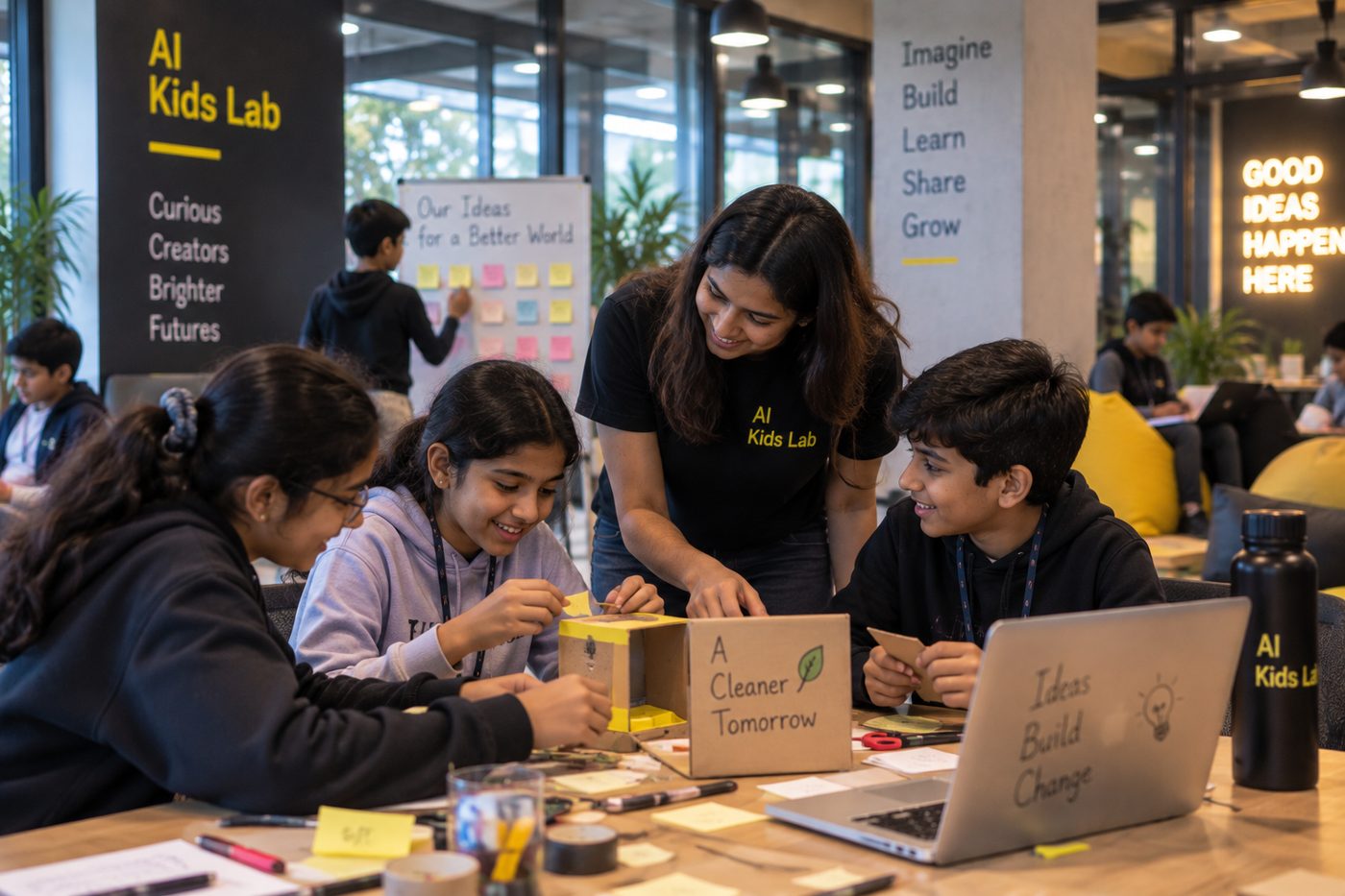
Now the hands-on part. One student drives, the other explains what they think is happening, and they swap halfway. For the Data domain, play rock-paper-scissors against an AI that learns your habits and watch its memory fill up. For Computer Vision, turn a drawing into numbers. For NLP, try to fool a mood-reading AI.
Let them find the failure cases themselves. The moment a student says "it got that wrong because…" is the moment they've understood it.
Which order sparks more curiosity in an AI period?
25–30 min: Name it
Only now introduce the vocabulary, and keep it to one line students can write down. Data AI: data → pattern → prediction. Because they've just watched it happen, the words attach to something real instead of floating.
30–40 min: Check, with instant feedback
Six short questions. Count it as "mastered" at about 80%. When a student gets one wrong, note which idea it was, not just the score — that list becomes next week's opening five minutes. A projector plus a show of hands works fine; so does a quiz tool. What matters is that the feedback, and the reason, arrive immediately.
40–45 min: The exit question
End with one "why?" question and one "where?" question. Why did the AI's answer change? Where did you see AI today before you got to school? The second sends them home noticing AI everywhere, which is exactly the habit the unit is trying to build.
Predict before you explain. Pairs, with roles — one drives, one explains. No public rankings — celebrate class progress instead. Celebrate fixed mistakes as loudly as right answers. Keep a misconception wall, and take ideas down when the class has fixed them.
Try it tomorrow
You can run tomorrow's period with our free AI Reflection lesson. Put it on the projector and let the class vote on each answer, or let pairs play on lab computers. It follows this structure, tracks mistakes and brings them back, and needs no sign-up. For the reasoning behind the design, read what Duolingo gets right that most AI lessons get wrong.
AI Kids Lab turns the CBSE AI curriculum for Grades 7, 8 and 9 into gamified lessons designed by product engineers, inside your school's existing timetable. Try a free lesson (no sign-up), or book a 30-minute call.
Talk to us on WhatsApp