Engine before app: why most school AI programs teach nothing
Pick a template, connect an AI service, add some buttons. It feels productive, it demos beautifully, and it teaches almost nothing about AI. Here is the reverse order, and why it works.
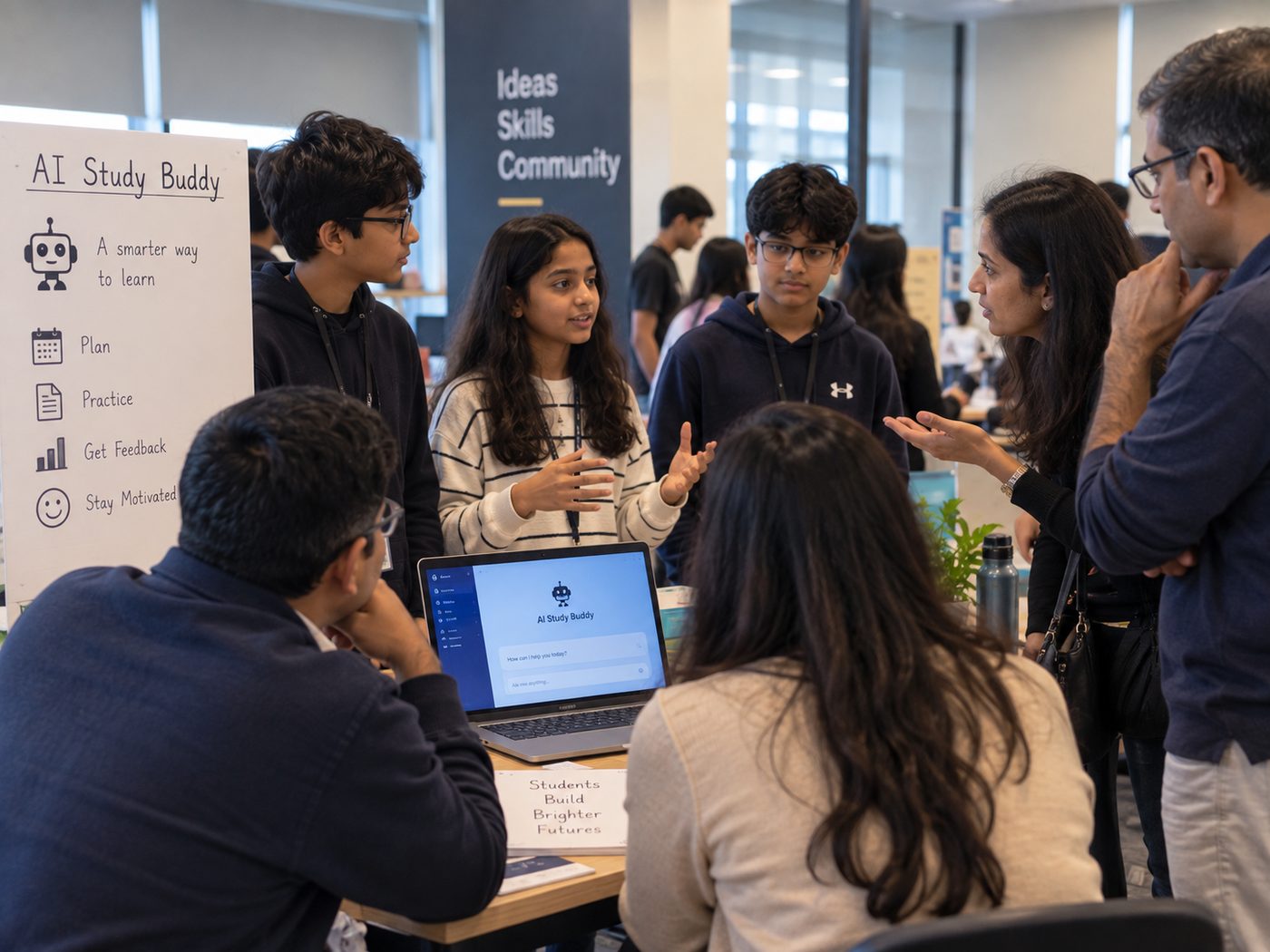
Here is a demo you have probably seen at a school tech showcase. A Grade 8 student presents an app. It has a clean interface, a login screen, a chat box. You type a question about the syllabus and it answers. The room applauds.
Now ask the student one question: how does it decide what to say?
Nine times out of ten the honest answer is "I connected it to the AI." The app is real. The learning is not. What the student built was screens, a form and a call to somebody else's model — which is a legitimate software skill, and is not artificial intelligence.
Why app-first is so tempting
Because it works, immediately, and it photographs well. A template plus an API key produces something demo-ready in a single period. Everyone feels productive. The teacher has evidence, the student has a screenshot, the school has a showcase.
The trouble is that an application is mostly not AI. It is overwhelmingly interface, state, storage and authentication. Building one teaches a student about buttons and databases, and leaves the model itself as a black box behind an endpoint — which is precisely the thing they were supposed to stop treating as magic.
The reverse order
Build the engine first. Solve a real problem with it second. Add the interface last, when it turns out to be the easy part.
In practice that sequence looks something like this, spread across a year:
- Train something with no code at all. A gesture or sound classifier, trained on the student's own webcam and microphone. Thirty samples per class, hit train, test it on a classmate, then deliberately find an input that fools it. In forty minutes a twelve-year-old has met training data, test data, confidence scores and failure modes — physically, not as vocabulary.
- Write the smallest possible model by hand. A nearest-neighbours classifier in about fifteen lines that reads handwritten digits. The student writes the distance calculation themselves. Suddenly "the computer learnt it" becomes "it measured which examples were closest."
- Build one neuron. Weights, a bias, a weighted sum, and the update rule. Print the weights each round and watch them settle. Then watch it fail on a problem one straight line cannot separate — which is exactly the motivation for depth, arriving at the moment the student needs it.
- Stack them into a network. Now a loss curve means something, because the student has seen a single neuron's error shrink by hand.
- Only then, the interface. Wrap the working engine in something a person can use, put it in front of real users, and fix what confuses them.
Python arrives when it is needed, not before
A common mistake is a term of Python syntax before any AI. Variables, loops and functions in the abstract, with the interesting part promised for later. Most students lose interest somewhere around nested loops, and the ones who survive have learnt programming, not machine learning.
The alternative is to let the first Python program a student writes be a working classifier. Variables, lists, loops and functions all appear because the classifier needs them. The syntax is scaffolding for something the student already wants to build.
The practical device that makes this work is a notebook where the plumbing is already written and the important line is blank. The student does not type boilerplate for twenty minutes. They write the distance formula, or the learning rule, or the prompt, or the evaluation — the part that carries the idea.
Where AI coding assistants fit
They fit after the student has written the core ideas by hand, for the same reason a calculator comes after arithmetic. A tool speeds up what you understand and hides what you do not. Introduce an assistant in Grade 7 and you get students who can produce code and cannot read it. Introduce it once they have built a perceptron by hand and you get students who can direct it, spot when it is wrong, and fix it.
A Grade 8 student's chatbot answers syllabus questions. Asked how it decides, they say “I connected it to the AI.” What did the project mostly teach?
The test
You can evaluate any school AI program, including ours, with the question at the top of this piece. Walk up to a student at the showcase, point at their project, and ask how it decides.
If they explain what it was trained on, what it measures and where it breaks, the program is teaching AI. If they tell you which service they connected to, it is teaching app assembly. Both are worth something. Only one of them is what your syllabus asked for.
AI Kids Lab turns the CBSE AI curriculum for Grades 7, 8 and 9 into gamified lessons designed by product engineers, inside your school's existing timetable. Try a free lesson (no sign-up), or book a 30-minute call.
Talk to us on WhatsApp